All Categories
Featured

Emerging Future Shifts Shaping the 2026 GCC Market
Table of Contents
To reverse a years of weakening overall element performance, regional labour market policy is shifting from basic job production to managing active workforce transitions. Federal governments and employers are scaling short, modular training programmes and micro-credentials in information analytics and digital operations to equip employees for emerging roles. Workplace-based learning and apprenticeship-style pathways are becoming more common as companies incorporate AI tools into everyday workflows.
With oil costs anticipated to typical $55-60 per barrel in 2026, local governments are heightening their focus on expenditure discipline and personal capital mobilisation. Fiscal policy is pivoting towards the monetisation of state-owned assets in logistics, utilities, and desalination to redirect funds towards higher-impact investments. While borrowing by means of sukuk and sustainability-linked bonds is anticipated to increase to money tactical deficits, the focus remains on enhancing non-oil earnings structures.
PwC Middle East economic policy and strategy partner Jing Teow said: "Having currently mobilised capital and policy at scale, GCC governments are now focused on shipment. In 2026, the top priority is reinforcing economic strength through more protected trade and financial investment relationships, reliable AI implementation, managed workforce transitions and disciplined financial policy in a more tough and fragmented international environment.".

Saudi Arabia and UAE are poised to lead the Gulf area's financial expansion in 2026, supported by strong private-sector performance, resistant domestic need and restored financial investment momentum, according to the newest ICAEW Economic Insight Q4 2025 report, produced by Oxford Economics. The GCC is anticipated to exceed most global areas peers next year, with local GDP projection to grow by 4.4%. Throughout the GCC, non-energy activity is forecasted to broaden by 4.1% in 2026, driven by strong labour markets, improving credit conditions and increasing investment in innovation and AI-related facilities.
Oil profits will be under pressure in the very first half of 2026, production is anticipated to increase again in the second half of 2026, supporting the area's medium-term outlook, it specified. Saudi Arabia will stay a major contributor to GCC momentum, with GDP forecast to grow 4.3% in 2026.
Analysing New GCC Research for Future Insights
Growth will be supported by commercial growth and policy reforms, including alleviated foreign ownership rules that intend to stimulate more investment. The fiscal deficit is forecasted to widen to 5.6% of GDP next year amidst softer oil prices, while the current five-year rent freeze in Riyadh aims to reduce inflationary pressures, though it might constrain future housing supply.
Strong domestic fundamentalsThe UAE is also placed for another strong year of performance, with GDP forecast to increase 5.6% in 2026 as non-oil sectors continue to expand. Tourist, trade and monetary services stay crucial growth chauffeurs, supported by population growth and sustained domestic demand. Dubai's economy grew 4.4% in the very first half of 2025, reflecting broad-based non-oil strength.
Oil production is expected to get once again in the 2nd half of 2026, complementing continuous financial investment in infrastructure, technology and global trade partnerships. Hanadi Khalife, the Head of Middle East, ICAEW, stated: "This quarter's outlook strengthens how far the GCC has actually can be found in building varied, resistant and worldwide competitive economies.
Bridging Strategy and Operational Performance Across the GulfScott Livermore, ICAEW Economic Advisor, and Chief Economist and Handling Director, Oxford Economics Middle East, stated: "Saudi Arabia and the UAE are going into 2026 with strong foundations. Saudi non-oil activity is acquiring rate, supported by robust demand and increasing investment, even as financial pressures increase.""The UAE continues to benefit from strong domestic fundamentals, a sharp uplift in federal government costs and continual diversity efforts.
Optimising Operational ROI through Advanced Business Planning
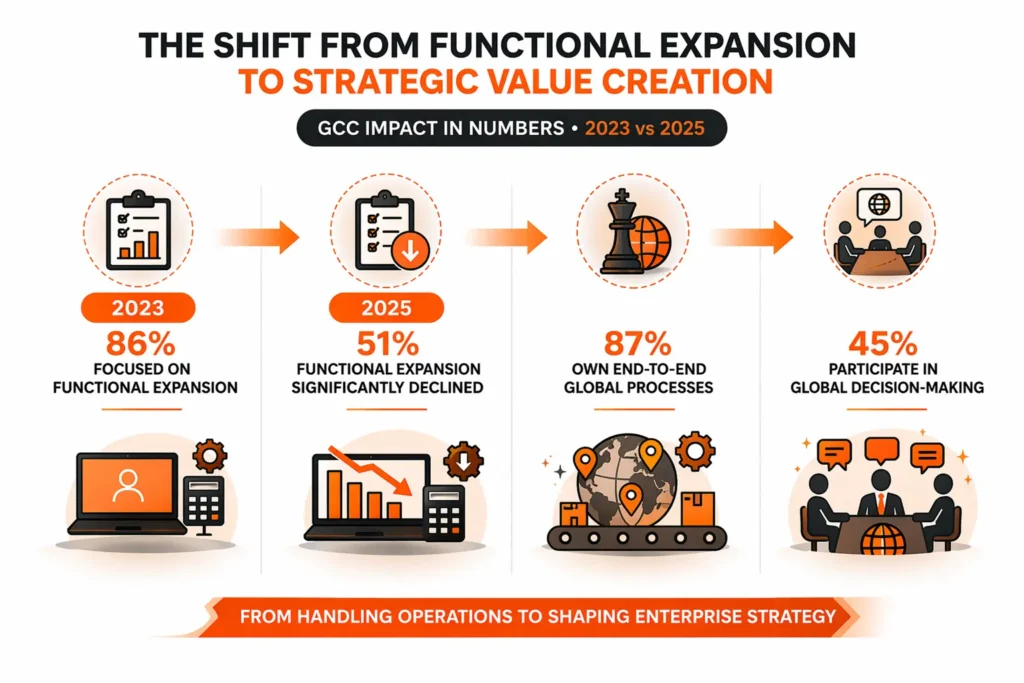
What differentiates 2026 from preceding years is not just the acceleration of technological modification, though that velocity is genuine, but rather a fundamental shift in how enterprises envisage their GCCs' purpose. The is expected to grow to 4 hundred thirteen billion dollars by 2040, however this development masks a more profound change.
Instead, they ask whether these centers drive development, own profit-and-loss obligation, and add to competitive differentiation. In 2026, the most successful GCCs will behave like internal startups, nimble, cross-functional, insight-driven, and deeply lined up with worldwide service outcomes. This shift from execution to ownership represents possibly the single most substantial strategic recalibration in the GCC design's evolution.
Today, we're convening more than 3000 meetings between investors and 119 Gulf-listed business with a combined worth of $2.4 trillion at the HSBC GCC Exchanges Conference 2026, in London. We're uniting financiers, business, exchanges, and policymakers to discuss what is changing in the area, and what comes next, consisting of the growth and ongoing advancement of the Gulf's capital markets, and the area's growing role in international networks of capital and trade.

Latest Posts
Middle East News: Strategic Market Trends in 2026

Emerging Future Trends Shaping the 2026 GCC Economy

The Strategic Guide to Regional Industrial Success for 2026