All Categories
Featured
Why Does Operational Excellence Vital for Future Expansion?
Table of Contents
July 2025: ADQ and Energy Capital Partners concurred on a USD 25 billion venture to secure low-carbon power for data centers serving AI workloads. July 2025: Fujitsu unveiled its Technology and Service Vision 2025, highlighting AI-enabled cross-industry communities and net-positive outcomes. May 2025: Oracle restated its USD 1.5 billion Saudi financial investment to align with economic-prosperity efforts and broaden cloud areas.
February 2025: Cognizant got in a three-year alliance with Upsource by Solutions in Saudi Arabia to provide Gen-AI-powered financing automation. INTRODUCTION1.1 Study Assumptions and Market Definition1.2 Scope of the Study2. MARKET LANDSCAPE4.1 Market Overview4.2 Market Drivers4.2.1 Surge in hyperscale cloud-region releases throughout GCC4.2.2 Mandatory in-country data-residency and sovereignty rules4.2.3 Outsourcing push from Vision 2030 and other nationwide agendas4.2.4 Increasing cyber-insurance requirements driving handled security uptake4.2.5 AI-enabled service automation cutting total cost of ownership4.2.6 ESG-linked OPEX moving CAPEX workloads to MSPs4.3 Market Restraints4.3.1 Persistent scarcity of Arabic-speaking Tier-3 engineers4.3.2 Federal government "Saudization/Emiratization" hiring quotas4.3.3 High energy-pricing volatility for data-center operations4.3.4 Fragmented regulatory accreditations across GCC states4.4 Worth/ Supply-Chain Analysis4.5 Regulatory Landscape4.6 Technological Outlook4.7 Porter's Five Forces Analysis4.7.1 Threat of New Entrants4.7.2 Bargaining Power of Buyers4.7.3 Bargaining Power of Suppliers4.7.4 Risk of Substitutes4.7.5 Intensity of Competitive Rivalry4.8 Impact of Macro Trends4.9 Secret Market Considerations and Emerging Use-Cases5.
COMPETITIVE LANDSCAPE6.1 Market Concentration Analysis6.2 Strategic Relocations (M&A, Partnerships, Launches)6.3 Market Share Analysis (Top-15, 2024)6.4 Business Profiles (includes Worldwide Level Overview, Market Level Summary, Core Segments, Financials as readily available, Strategic Details, Market Rank/Share, Services And Product, Current Advancements)6.4.1 Etihad Etisalat Co. (Mobily)6.4.2 Emitac Enterprise Solutions LLC6.4.3 Saudi Telecom Company (stc)6.4.4 Hewlett Packard Business Company6.4.5 ACS Group6.4.6 International Business Machines Corporation6.4.7 Diyar United Company6.4.8 Ooredoo Q.P.S.C. 6.4.9 Wipro Limited6.4.10 AGC Networks Limited6.4.11 MEEZA QSTP-LLC6.4.12 Emirates Integrated Telecom Business PJSC (du)6.4.13 Injazat Data Systems LLC6.4.14 Gulf Business Machines (GBM)6.4.15 Fujitsu Ltd.
MARKET OPPORTUNITIES AND FUTURE TRENDS7.1 White-space and Unmet-Need Assessment **Subject to Accessibility Managed services are the practice of outsourcing the obligation for maintaining and anticipating the need for a variety of procedures and functions, ostensibly for the purpose of improved operations and reduced financial expenses through the decrease of straight utilized staff.
How Does Business Excellence Crucial for 2026 Growth?
The marketplace sizes and forecasts are provided in regards to value in USD for all the above sectors. By Managed Service TypeManaged Facilities ServicesManaged Hosting ServicesManaged Security ServicesManaged Cloud ServicesDisaster Healing and Company ContinuityNetwork and Communication ServicesEnd-user Assistance ServicesManaged IoT ServicesBy End-user VerticalIT and TelecomBFSIOil and GasHealthcareGovernmentRetail and E-commerceEducationManufacturingEnergy and UtilitiesBy Service Shipment ModelRemote/ Off-site Managed ServicesOn-site/ Field Managed ServicesHybrid ModelCo-managed ServicesBy Company SizeLarge EnterprisesSmall and Medium-sized Enterprises (SMEs)By Deployment EnvironmentOn-premisePublic CloudPrivate CloudHybrid CloudBy GeographySaudi ArabiaUnited Arab EmiratesQatarKuwaitOmanBahrain The GCC Managed Services Market size is anticipated to reach USD 12.35 billion in 2026 and grow at a CAGR of 8.84% to reach USD 18.87 billion by 2031. In 2026, the GCC Managed Services Market size is anticipated to reach USD 12.35 billion.
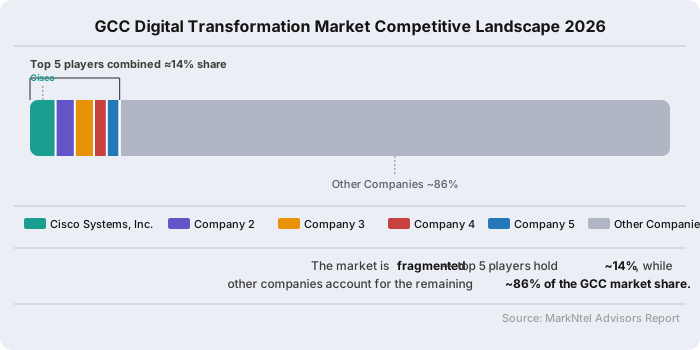
(Mobily), AGC Networks (An ESSAR Company), EITC Group (du), Saudi Telecom Company and IBM Corporation are the major business running in the GCC Managed Provider Market. In 2025, the GCC Managed Provider Market size was estimated at USD 12.35 billion. The report covers the GCC Managed Solutions Market historical market size for many years: 2019, 2020, 2021, 2022, 2023 and 2024.
Forward-Thinking Operational Excellence Within 2026 MarketsPage last updated on: January 28, 2026.
In times of local uncertainty, survival is no longer about development, it has to do with resilience. Throughout the Middle East, particularly in the GCC, companies are dealing with increasing pressure: Market volatility Tight liquidity Increasing functional expenses Greater governance expectations Yet, numerous companies are still running with limited monetary exposure and inefficient processes.
Major Developments in the Future GCC Economy
From what I'm seeing on the ground, companies that will make it through and sustain are those that act now: Strengthen capital discipline Not simply reporting, but active cash forecasting, situation planning, and working capital optimization. Repair the foundation: processes & controls Clear, recorded, and imposed processes are no longer a "great to have": they are important for stability.
Embed governance and accountability Strong policies, clear ownership, and ethical practices are what protect services in unpredictable times. Think beyond finance, integrate compliance & danger Siloed functions are a high-end business can no longer pay for.
In 2025, the GCC was a worldwide outlier for company confidence, however 2026 has brought a new set of financial and political truths. While experts in the area may have delighted in some easy wins in the past, those days appear to be behind them. Based upon a study of senior purchasers and up-to-the-minute Pulse Study information from March 2026, this report offers the roadmap for seeking advice from firms to browse regional instability and a developing client base.

Latest Posts
Middle East News: Strategic Market Trends in 2026
Emerging Future Trends Shaping the 2026 GCC Economy

The Strategic Guide to Regional Industrial Success for 2026